Last updated: September 2026
This page contains affiliate links. If you buy through them, we may earn a commission at no extra cost to you. As an Amazon Associate I earn from qualifying purchases.
Over-the-door pantry organizers look like free space for small apartments—until a bifold hits the rack, a hollow door flexes, or the unit scrapes the frame every time you close it.
This guide shows when an over the door pantry organizer apartment setup actually works—and when a slim cart, shelf risers, or under-sink system is safer for your deposit. Every pick here is no-drill, deposit-safe, and move-out ready if you choose hang-on hardware and respect weight limits.
Constraints we optimize for: no drill · deposit-safe · door-finish safe · move-out ready · small kitchens
For the wider zone map, see our small rental kitchen organization guide. For dry-goods systems that do not use the door, see pantry organization for renters.
Quick picks: when to use the door (and when to skip it)
| Your situation | Start here | Why |
|---|---|---|
| Solid pantry / closet door, clear swing | Slim over-the-door rack (6–8 pockets) | Uses dead vertical space; hangs with no screws |
| Bifold or sliding pantry doors | Skip the door → slim rolling cart | Bifolds bind; sliders leave no hang lip |
| Hollow lightweight door | Light spice / wrap rack only (under ~5 lb) | Heavy racks warp doors and scrape paint |
| No pantry door at all | Shelf risers + clear bins in upper cabinets | Door storage is optional—not required |
| Budget under ~$25 | Flat over-the-door spice / wrap holder | Cheap test before a tall pantry unit |
| Shared flat / roommate snacks | Labeled pocket organizer + shared cart | Door for personal snacks; cart for shared staples |
The 5-minute door fit check (do this before you buy)
1. Identify the door type. Solid hinged = best candidate. Hollow-core = light loads only. Bifold, accordion, pocket, or sliding = usually skip hang-on racks.
2. Measure the clearance sandwich. You need: door thickness (for hook depth), gap between door top and frame (hook clearance), and depth from the inside of the closed door to the nearest shelf or wall. Many returns happen because the rack hits shelves when the door shuts.
3. Check swing and soft-close. Soft-close hinges and tight frames hate thick metal hooks. If the door already rubs, add nothing.
4. Cap the weight. Read the product limit and cut it by ~30% for rental hollow doors. Heavy cans belong in a cart or lower cabinet—not swinging on a door.
5. Plan move-out. Prefer foam-padded hooks that lift off. Photograph the door finish before install so you can prove no damage later.
If any step fails, do not force an over-the-door unit. Use shelf risers or a slim rolling cart instead.
Category recommendations
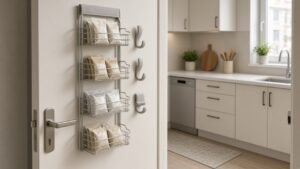
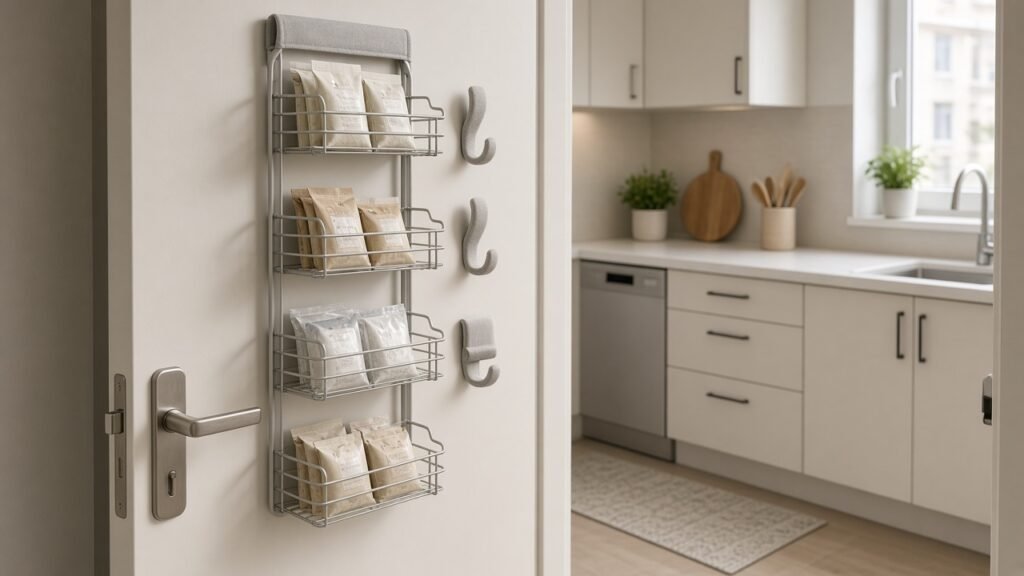
1) Slim over-the-door pantry rack (mesh / wire pockets)
Who it’s for: Apartments with a real pantry or utility closet door that swings clear.
Price band: $25–50 (taller units sometimes $50–80)
Pros: Huge vertical capacity; no drill; packs reasonably for moves. Cons: Needs clearance behind the closed door; can rattle; heavy when fully loaded.
Fit notes: Measure depth to the first shelf. Prefer shallow pockets for boxes and wraps; deep baskets for snacks. Keep total load under the door’s comfort limit—not just the rack’s printed max.
Shop: over the door pantry organizer
2) Over-the-door spice / wrap / foil rack
Who it’s for: Galley kitchens with no pantry—just a cabinet or closet door near cooking.
Price band: Under $25
Pros: Light; solves the “foil avalanche”; easy move-out. Cons: Low capacity; wrong door type still scrapes.
Fit notes: Hang on a cabinet door only if hinges are sturdy and the rack clears shelves. Many renters do better hanging wraps on a pantry/closet door and keeping spices on a magnetic spice rack on the fridge.
3) Over-cabinet-door caddy (inside kitchen cabinet doors)
Who it’s for: Sponges, lids, or cutting boards when counter and under-sink floor space are gone.
Price band: Under $25 to ~$35
Pros: Uses door dead space; usually hang-on. Cons: Can block soft-close; scrapes frames; low weight limits.
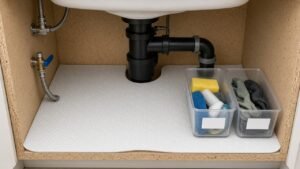
Fit notes: This is not a pantry solution. Pair with an under-sink mat and organizer setup so wet items stay off particle board. Skip flimsy hollow cabinet doors.
4) Fabric pocket over-the-door organizer (snacks / packets)
Who it’s for: Shared flats and studios that need labeled “mine / yours” zones.
Price band: Under $25
Pros: Soft on finishes; cheap; zones well with labels. Cons: Sags when overloaded; looks busy; not for cans.
Fit notes: Use for light packets, tea, and bars—not glass bottles. At move-out, empty pockets, wipe hooks, done.
5) When the door fails: freestanding backups (still no-drill)
If the door fails the fit check, these keep the same job without touching the door:
| Job you wanted | No-door backup | Link |
|---|---|---|
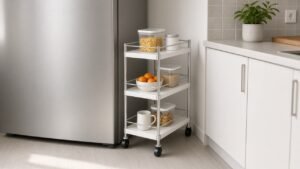
| Tall snack storage | Slim rolling cart in a gap | slim rolling carts |
| Vertical dry goods | Shelf risers + clear bins | shelf risers / pantry systems |
| Spices at eye level | Fridge-side magnetic rack | magnetic spice racks |
| Cleaning bottles | Tension rod + mat under sink | tension-rod method |
What belongs on the door (and what never should)
Treat the door as light vertical parking, not a second pantry floor.
Good on the door
- Foil, wrap, parchment, sandwich bags
- Snack packets, tea, instant packets
- Lightweight spice jars (or better: fridge magnets)
- Paper towels (only if the holder is rated and the door is solid)
- Cleaning cloths and spare sponges on an inside cabinet caddy
Keep off the door
- Full soup/veg cans and glass jars
- Gallon jugs and bulk oil
- Cast-iron or heavy cookware hangers meant for walls
- Anything that shifts and slams when the door swings
If you need heavy storage, build a no-drill pantry stack with bins and risers, then let the door handle overflow packets only.
Install tips that protect paint and deposits
- Pad the contact points. Many hangers include foam; if not, add thin felt pads where metal meets the door face.
- Center the load. A rack hanging crooked twists hinges over time.
- Leave hinge clearance. Do not bury soft-close mechanisms under thick hooks.
- Re-check after a week. Doors settle; a rack that cleared on day one can kiss a shelf after humidity changes.
- Unload before moving day. Carry the rack empty; never drag a loaded door unit down a hallway.
Shop lighter options first: over the door spice rack · over the door wrap organizer
Studio vs galley vs shared flat: door strategy
Studio / micro: You may only have a bathroom or closet door near the kitchen. Prefer a flat wrap/spice rack over a deep pantry tower. Pair with under-sink calm from our under-sink organizer guide.
Galley: Upper cabinets are shallow; a door rack on a utility closet often beats cramming more onto the counter. Keep the aisle clear—deep baskets that stick out when the door is open are a shin hazard.
Shared flat: Label pockets by person. Put shared bulk on a cart so roommate snacks do not migrate into “your” door zones. A weekend pass with the under-$75 kitchen reset keeps arguments down.
Comparison table
| Category | Best for | Door type needed | No-drill? | Price band | Move-out |
|---|---|---|---|---|---|
| Slim pantry rack | True pantry door | Solid hinged | Yes (hang-on) | $25–50+ | High |
| Spice / wrap rack | Light kitchen door use | Solid or sturdy hollow | Yes | <$25 | Very high |
| Over-cabinet caddy | Sponges / lids | Sturdy cabinet door | Usually | <$25–$35 | High* |
| Fabric pockets | Shared snacks | Most hinged doors | Yes | <$25 | Very high |
| Slim cart (backup) | No usable door | N/A | Yes | $25–50 | Very high |
\*Only if door-safe for your lease and hinges.
Build order: deposit-safe over-the-door setup (30–60 min)
- Empty the door area; wipe the top edge and hinges.
- Run the 5-minute fit check (type, clearance, swing, weight).
- Hang the empty rack and close the door slowly—listen for scrape or bind.
- Load light items first (wraps, packets), then snacks. Keep cans and glass off the door.
- Add labels if you share the kitchen.
- Photo the closed door and the hinge side for your move-out folder.
If the door binds at step 3, stop. Return the rack and pivot to a cart or risers—returns beat deposit deductions.
Mistakes to skip
| Mistake | Do this instead |
|---|---|
| Buying a tall rack for bifold doors | Slim cart or shelf risers |
| Loading full soup cans on a hollow door | Cans in lower cabinets or cart |
| Ignoring closed-door depth | Measure shelf gap before purchase |
| Screwing hooks into landlord doors | Hang-on only; padded hooks preferred |
| Using the door as your only pantry | Combine with bins / risers / cart |
| Skipping the scrape test | Hang empty, close slowly, then load |
FAQ
What is the best over the door pantry organizer for an apartment?
A slim hang-on rack on a solid hinged pantry or closet door, kept under a conservative weight limit. If you only have bifold, sliding, or flimsy hollow doors, skip the category and use a slim rolling cart or shelf risers.
Will an over-the-door organizer work on bifold doors?
Usually no. Bifolds lack a stable top lip, bind easily, and can jump the track under side load. Treat bifold kitchens as “no door storage” and use freestanding systems instead.
Are over-the-door organizers deposit-safe?
They can be—if you use hang-on hardware, pad contact points, stay under weight limits, and remove cleanly at move-out. Screws, over-tight metal that digs into paint, and overloaded hollow doors are deposit risks.
How much weight can a rental door hold?
Follow the product limit, then cut it for hollow-core doors. A practical renter rule: keep door racks for light and medium items (wraps, snacks, spices) and park heavy cans elsewhere.
Do these work for UK/AU flats and cupboards?
Yes—same fit rules. This page uses US spelling (organizer / apartment / cabinet). UK/AU searches often use organiser, organisation, cupboard, and flat. Measure in centimetres the same way; bifold and hollow-door warnings still apply.
Over-the-door vs slim rolling cart—which should I buy first?
Buy the cart if your door fails the fit check or you move often. Buy the door rack only after a successful empty hang-and-close test. Many small kitchens eventually use both: door for light packets, cart for heavy staples.