Last updated: September 2026
This page contains affiliate links. If you buy through them, we may earn a commission at no extra cost to you. As an Amazon Associate I earn from qualifying purchases.
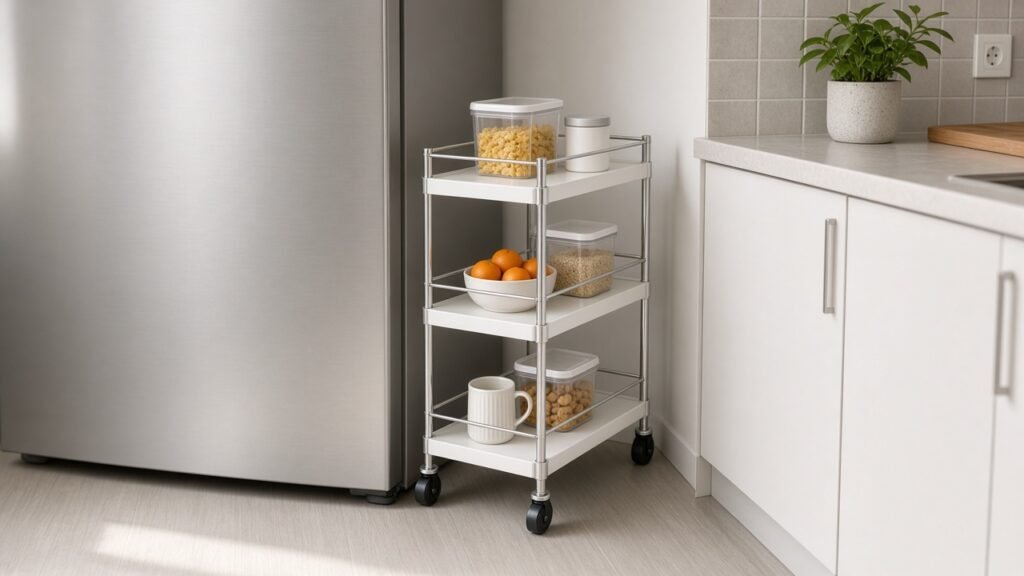
The most valuable square footage in a small rental kitchen is often a useless-looking gap—between fridge and wall, stove and counter end, or washer and pantry cupboard. A slim rolling cart turns that dead strip into a movable pantry aisle without drilling, without built-ins, and without arguing with the landlord.
This comparison focuses on best slim rolling carts for apartment kitchens: width bands that actually fit rental gaps, renter constraints (deposit-safe, freestanding, move-out ready), and the measurement mistakes that cause returns.
Constraints we optimize for: no drill · deposit-safe · narrow gaps · uneven rental floors · move-out ready
Pair a cart with zone bins from our pantry organization for renters guide, and keep the rest of the kitchen mapped in our small rental kitchen organization guide.
Quick picks by gap width
| Your gap (clear width) | Start here | Why |
|---|---|---|
| ~4–5 inches (10–13 cm) | Ultra-slim 3–4 tier metal cart | Only true “slot” carts clear fridge handles + baseboards |
| ~5.5–7 inches | Slim utility cart with baskets | Best capacity-to-width balance for most apartments |
| ~7–9 inches | Standard slim rolling cart / trolley | Room for oils, cans, and a cutting board slot |
| Budget (under ~$40) | Basic 3-tier slim cart | Confirm wheel quality and exact width in specs |
| Shared flat | Cart + labeled bins on each tier | One mobile zone; less shelf fighting |
If your “gap” is really a full open end of a galley, you can size up—but still prefer freestanding carts over screw-in pantry pull-outs.
Measure twice (the renter gap checklist)
Most returns happen because people measure the pretty gap at eye level and ignore the ugly constraints lower down.
1. Find the narrowest point. Measure at three heights: floor/baseboard, mid fridge, and handle flare. Use the smallest number.
2. Subtract play. Leave 0.5–1 inch (1–2.5 cm) total clearance so the cart rolls without scraping paint or vinyl.
3. Check depth and path. Can the cart roll forward past the fridge door swing? Will it clear the dishwasher door or oven handle?
4. Check floor type. Thick vinyl, threshold strips, and soft wood can fight small wheels. Locking casters help on slight slopes.
5. Check height under upper cabinets. Tall carts look great online and then hit the underside of a wall cabinet when parked.
6. Stay freestanding. No wall brackets. No anti-tip kits that need screws into landlord plaster unless the lease explicitly allows it and you accept patching.
What “slim” actually means (comparison framework)
Retailers label almost everything “slim.” For apartments, use width bands:
| Label we use | Typical exterior width | Realistic use |
|---|---|---|
| Ultra-slim | ~4–5.5 in | Spices, wraps, cans in a single file; fridge/wall slots |
| Slim | ~5.5–7.5 in | Everyday apartment hero; mixed dry goods |
| Narrow standard | ~7.5–10 in | End-of-counter parking; not a true fridge slot |
Always read the product width including frame, not basket width alone. Handles and flared lips matter.
Category / type recommendations
1) Ultra-slim metal rolling cart (fridge-slot specialist)
Who it’s for: True 4–5 inch gaps beside a fridge or wall.
Price band: $35–70
Pros: Fits gaps other carts cannot; vertical capacity; fully reversible at move-out. Cons: Low per-shelf volume; tippy if top-loaded; metal edges can scuff if forced.
Fit notes: Prioritize published overall width. Prefer carts with a low center of gravity and locking wheels. Store heavy cans on the bottom tier. Do not hang towels that catch on the fridge gasket.
Shop: ultra slim rolling cart 4 inch
2) Slim 3–4 tier utility cart with baskets
Who it’s for: The common 5.5–7 inch apartment gap; studios that need a fake pantry.
Price band: $40–80
Pros: Best everyday capacity; baskets contain spills; easy to assign zones (snacks / cooking / cleaning). Cons: Basket lips add width; plastic baskets flex; some “slim” listings are 8+ inches—verify.
Fit notes: Confirm exterior width and basket removable clearance. Mesh sides help you see inventory; solid sides hide visual clutter in open studios.
Shop: slim rolling utility cart kitchen
3) Slim wood / bamboo trolley (aesthetic open kitchens)
Who it’s for: Open-plan studios where the cart is always visible.
Price band: $50–100+
Pros: Warmer look than chrome; often includes a butcher-block style top for temporary prep. Cons: Heavier; humidity near dishwashers can swell cheap bamboo; wider than metal slot carts.
Fit notes: Measure like any other cart—beauty does not shrink baseboards. Keep wet bottles on a tray, not raw wood.
Shop: bamboo slim rolling kitchen cart
4) Slim cart with drawers (semi-enclosed)
Who it’s for: Shared flats and open shelves that look chaotic.
Price band: $45–90
Pros: Hides visual noise; drawers act like mini pantry drawers. Cons: Drawers need clearance to open; mechanisms fail if overfilled; harder to clean crumbs.
Fit notes: Add drawer-front clearance to your gap math if the cart sits tight against a wall. Prefer soft-close only if quality reviews are strong—cheap slides stick.
Shop: slim rolling cart with drawers kitchen
5) Nesting / folding rolling cart (frequent movers)
Who it’s for: Sublets, short leases, and anyone who moves every 12 months.
Price band: $30–60
Pros: Collapses or nests for the moving van; still freestanding day to day. Cons: Less rigid; lower weight ratings; folding joints can pinch fingers.
Fit notes: Test wheels after every reassembly. Keep a photo of the folded dimensions for your next apartment hunt.
Shop: folding rolling utility cart kitchen
6) Wide “slim” cart used as an island substitute (not a gap filler)
Who it’s for: Galley kitchens with open floor space but no island.
Price band: $40–80
Pros: Prep landing + storage; rolls out of the way for dinner parties. Cons: Will not fit fridge slots—do not buy this when your problem is a 5-inch gap.
Fit notes: If your real need is vertical cabinet storage, consider shelf risers before a wide cart.
Side-by-side comparison
| Type | Best gap | Capacity | Stability | Move-out | Watch-outs |
|---|---|---|---|---|---|
| Ultra-slim metal | 4–5.5 in | Low–med | Medium | Excellent | Tip risk; scuffs |
| Slim basket cart | 5.5–7.5 in | High | Good | Excellent | Verify true width |
| Wood / bamboo | 6–9 in | Med–high | Good | Good | Moisture; weight |
| Drawer cart | 6–9 in | Med | Good | Good | Drawer clearance |
| Folding / nesting | Varies | Low–med | Fair | Excellent | Flex; wheel quality |
| Wide island-style | Open floor | High | Good | Good | Not a slot cart |
How to load a slim cart (so it does not tip)
- Heavy on the bottom — cans, bottles, small appliances.
- Daily mid — oils, salt, cooking staples in a small caddy.
- Light on top — wraps, snacks, towels (short stacks only).
- One tray rule — liquids sit on a rimmed tray to catch drips before they hit vinyl.
- Lock wheels when parked beside a fridge on a slight floor slope.
- Do not use as a ladder — ever. Carts are not step stools.
For spice overflow that should not live on a cart, consider a magnetic spice rack on the fridge instead of topping out the tallest tier.
Build order: gap-to-pantry in one hour
- Empty the gap; vacuum baseboards and the fridge coil side if accessible.
- Measure narrowest width, depth path, and max cart height.
- Order (or unpack) a cart in the correct width band—resist “close enough.”
- Soften contact points: felt pads on wall-facing frame corners if the cart might kiss paint.
- Load heavy → light; assign labels if you share the kitchen.
- Roll fully out and back three times to confirm door swings.
- Photo the parked cart for move-out inventory; keep the carton if you move within a year.
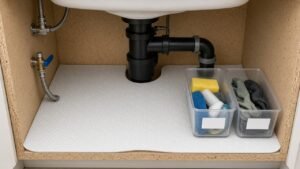
Connect the cart to a full dry-goods system with pantry organization for renters, and keep under-sink chemicals out of food tiers—use the under-sink guide.
Mistakes to skip
| Mistake | Do this instead |
|---|---|
| Measuring only at eye level | Measure baseboard + handle flare; use the smallest number |
| Buying “slim” without reading width | Match exterior width to gap minus clearance |
| Top-loading cans | Heavy bottom, light top |
| Parking in the oven door arc | Test full appliance swings before you commit |
| Screw-in anti-tip brackets by default | Prefer stable freestanding design; skip screws on rentals |
| Using the cart for wet mop buckets | Keep a separate cleaning caddy; protect floors and wheels |
FAQ
What is the best slim rolling cart for an apartment kitchen?
The best cart is the one that clears your narrowest measured gap. For most US apartments that is a 5.5–7.5 inch slim basket cart. True fridge slots closer to 4–5 inches need an ultra-slim metal cart.
How narrow can a kitchen rolling cart be?
Ultra-slim models start around 4–5 inches wide, but capacity drops fast. If your gap is under ~4 inches after clearance, a cart may not be realistic—use bins, risers, and magnetic spice storage instead.
Will a slim cart damage rental floors or walls?
Usually no if you leave clearance, avoid forcing scrapes, and use locking wheels on slopes. Add felt where metal might kiss paint. Do not drill wall brackets.
Can I use a slim cart as a pantry with no cupboard?
Yes—that is one of the best no-pantry strategies for studios. Zone the tiers and pair with clear pantry bins so bags do not avalanche when you roll.
Do these work for UK/AU flats and fridge gaps?
Yes. This page uses US spelling (apartment / organizer). UK/AU readers often search flat, trolley, and organiser. Measure in centimetres; the gap logic is identical. Confirm caster style for local vinyl/laminate floors.
Slim cart vs shelf risers—which first?
If you have a real unused gap, cart first. If your cupboards are deep and messy but every floor gap is blocked, buy shelf risers and bins before a cart you cannot park.