Last updated: September 2026
This page contains affiliate links. If you buy through them, we may earn a commission at no extra cost to you. As an Amazon Associate I earn from qualifying purchases.
Rental kitchen drawers are rarely the size on the box. They are shallow, sticky, split by a weird center rail, or so narrow that a “universal” utensil tray leaves a rattling canyon on one side. The fix is not drilling custom inserts into landlord cabinetry—it is choosing drawer organizers for small drawers that expand, nest, or modularize, then packing them when you move.
This roundup covers no-drill, deposit-safe, move-out ready organizers for tiny rental drawers: expandable utensil trays, deep-drawer peg systems, spice inserts, and junk-drawer modules.
Constraints we optimize for: no drill · deposit-safe · shallow/narrow drawers · sticky rental slides · move-out ready
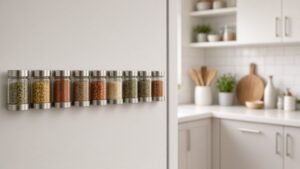
For the wider kitchen system, see small rental kitchen organization. Spices that will not fit a drawer can move to a magnetic fridge-side rack.
Quick picks: utensil / junk / spice / deep
| Your drawer problem | Start here | Why |
|---|---|---|
| Narrow utensil drawer | Expandable utensil tray | Adjusts to odd widths without gaps |
| Shallow “junk” drawer | Modular small bins / honeycomb | Carve zones without one rigid tray |
| Spice drawer (if you have one) | Tiered spice insert / expandable | Labels up; no door drilling |
| Deep pot drawer | Pegboard-style freestanding dividers | Stops lid avalanches; no screws |
| Budget (under ~$25) | One expandable tray + 2 small bins | Highest calm-per-dollar |
| Shared flat | Labeled modular bins | Clear ownership; fewer fights |
How to choose (5-minute renter checklist)
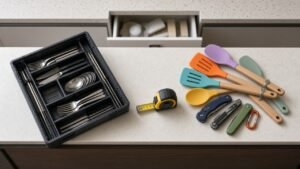
1. Measure the usable interior. Width and depth inside the drawer box, not the face. Note height to the drawer above when open—tall inserts fail in shallow boxes.
2. Note obstacles. Center rails, warped bottoms, sticky vinyl liners, and soft-close hardware that steals depth.
3. Prefer adjustable or modular. Expandable trays and interlocking bins beat one fixed “large” organizer that almost fits.
4. Stay freestanding. No screw-down knife blocks inside drawers unless the lease allows and you accept holes. Non-slip pads are fine; permanent adhesive liners can fight deposits—use removable liners only.
5. Buy for move-out. Nesting trays and small modules pack better than one giant custom cutout.
6. Edit tools first. Organizers do not fix 14 spatulas. Declutter before you measure for capacity.
Category recommendations
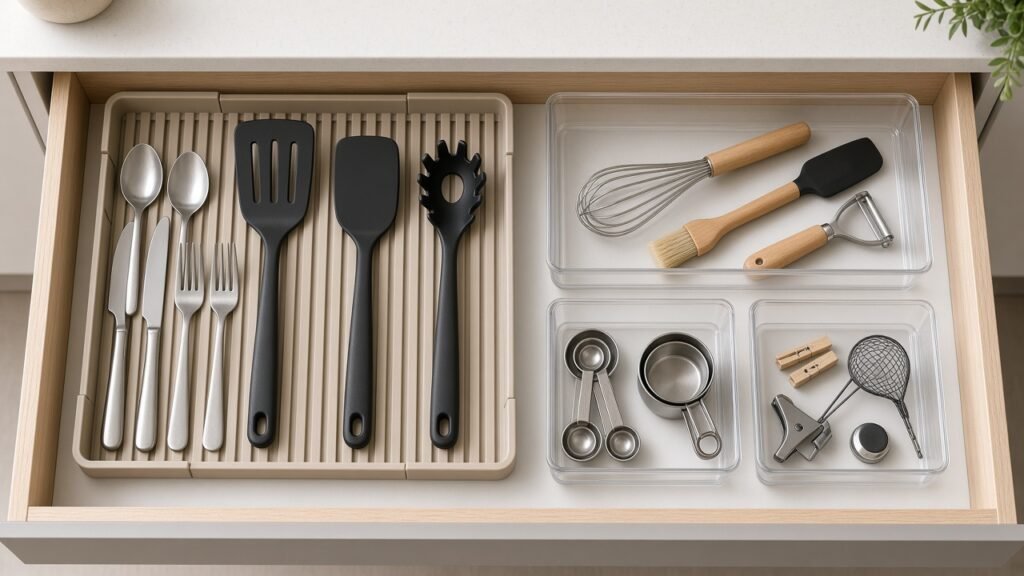
1) Expandable utensil drawer organizer
Who it’s for: The classic silverware drawer that is never a round number of inches wide.
Price band: $15–35
Pros: Width adjusts; usually includes common utensil wells; freestanding; easy move-out. Cons: Cheap plastic flexes; expansion joints collect crumbs; depth may still be too long for shallow rentals.
Fit notes: Expand until snug—not forced. If the drawer is very shallow front-to-back, look for “compact” or short-depth trays. Leave a finger gap at the back so the tray does not jam on soft-close hardware.
Shop: expandable utensil drawer organizer
2) Modular interlocking drawer bins (junk + misc)
Who it’s for: Batteries, bag clips, twist ties, spare lids, and the chaos drawer every rental grows.
Price band: Under $25 for a starter set; $25–40 for larger kits
Pros: Build the layout you need; rearrange after every grocery season; perfect for shared flats with labeled zones. Cons: Many tiny pieces to pack; can slide if the drawer bottom is slick—add a non-slip liner.
Fit notes: Start with 4–6 modules, not 20. Measure height so bins clear the drawer above. Clear bins beat opaque for “where is the thermometer?” moments.
Shop: modular drawer organizer bins
3) Deep drawer peg / freestanding divider systems
Who it’s for: Pot-and-pan drawers or deep lower drawers common in newer apartments.
Price band: $25–50
Pros: Custom lanes without screws; keeps lids vertical; reconfigurable. Cons: Needs enough clear height; pegs migrate if the base is cheap; overkill for a single shallow drawer.
Fit notes: Confirm the base tray fits your drawer footprint with ~0.5 inch total play. Heavy cast iron goes in fewer, wider lanes—not tiny grids.
Shop: deep drawer pegboard organizer
4) Knife tray / in-drawer knife block (freestanding)
Who it’s for: Renters who will not mount a magnetic strip (paint/drywall concerns) and will not leave knives loose.
Price band: $15–40
Pros: Safer than a rattling pile; freestanding options exist; move-out friendly. Cons: Steals a lot of drawer real estate; tall handles hit upper drawers; low-quality slots dull edges.
Fit notes: Measure knife height with the drawer closed. If height fails, use a counter knife block with a non-slip base—or a fridge magnetic strip only if it is truly magnetic-safe and leaves no residue (test first).
Shop: in drawer knife organizer tray
5) Tiered / expandable spice drawer organizer
Who it’s for: Drawers dedicated to spices—or a deep drawer you can claim for spices.
Price band: $18–40
Pros: Angled tiers show labels; no wall drilling; better than a crowded spice cabinet for many renters. Cons: Needs drawer depth; jar diameter varies; not ideal if you only have one shallow utensil drawer.
Fit notes: Measure jar height at an angle. Standard grocery jars differ from slim spice tins. If you lack a spice drawer, use a magnetic spice rack on the fridge instead of forcing this insert.
Shop: spice drawer organizer insert
6) Bamboo / wood expandable trays (visible open kitchens)
Who it’s for: Studios where open drawers are part of the aesthetic—or anyone who hates rattly plastic.
Price band: $20–45
Pros: Stiffer than bargain plastic; looks calmer; often expands smoothly. Cons: Heavier; can stain if wet utensils sit; costs more per inch.
Fit notes: Wipe dry before closing. Same width rules as plastic expandables. Avoid soaking bamboo trays in the sink.
7) Lid organizers / vertical tray files (for lid drawers)
Who it’s for: The lower drawer that became a plastic-lid landfill.
Price band: Under $25–35
Pros: Vertical slots stop avalanches; freestanding wire or plastic options; quick wins. Cons: Odd-shaped lids still misbehave; may need a second bin for containers.
Fit notes: Pair lids with a matching container zone—organizing lids alone does not fix the stack of bases on the counter. Declutter unmatched lids first.
8) Removable non-slip liner (base layer)
Who it’s for: Every slick rental drawer.
Price band: Under $15
Pros: Stops organizers sliding; softens rattle; peels up at move-out if you choose removable material. Cons: Thick liners steal height; permanent adhesives can fail deposit inspections—prefer non-adhesive grippy liners.
Fit notes: Trim with scissors; leave a small margin so liner does not bunch in the slide path.
Comparison table
| Category | Best for | Adjustable? | Price band | Move-out |
|---|---|---|---|---|
| Expandable utensil tray | Silverware | Width | $15–35 | Very high |
| Modular bins | Junk / shared | Layout | <$25–$40 | Very high |
| Peg / divider base | Pots / deep drawers | Layout | $25–50 | High |
| In-drawer knife tray | Safe knives | Low | $15–40 | High |
| Spice drawer insert | Spice drawers | Often width | $18–40 | High |
| Bamboo expandable | Utensils + look | Width | $20–45 | High |
| Lid organizer | Lid chaos | Low–med | <$25–$35 | High |
| Non-slip liner | All drawers | Trim-to-fit | <$15 | Very high |
Build order: tiny-drawer reset (45–75 min)
- Empty drawers onto a towel. Trash duplicates and mystery utensils.
- Wipe drawers; remove crumbly old liner if it peels cleanly.
- Lay non-adhesive non-slip liner where organizers will sit.
- Install the expandable utensil tray in the silverware drawer—snug, not forced.
- Build a modular bin grid in the junk drawer; label if you share.
- Add spice insert or route spices to a magnetic fridge system.
- Use peg dividers or a lid file only in drawers deep enough to justify them.
- Photo interiors for move-out; nest spare organizers in a moving tote.
Keep cabinet vertical space working with shelf risers, and park overflow dry goods with pantry bins and carts.
Mistakes to skip
| Mistake | Do this instead |
|---|---|
| Buying a fixed “large” tray by eye | Measure interior width/depth; prefer expandable |
| Organizing before decluttering | Edit utensils first |
| Permanent sticky liner | Removable non-slip liner only |
| Tall knife insert in a shallow drawer | Short tray or counter block |
| One giant junk tray | Modular bins with labels |
| Forcing a spice insert into the only utensil drawer | Magnetic spice rack or cabinet turntable |
FAQ
What drawer organizers work best for small rental drawers?
Expandable utensil trays plus modular bins solve most tiny drawers. Add a spice insert only if you have a dedicated drawer; otherwise use fridge-side magnetic storage.
Can I install drawer organizers without drilling?
Yes. Choose freestanding expandable trays, interlocking bins, peg bases, and removable liners. Skip screw-down inserts unless your lease allows holes you will fill later.
How do I measure for an expandable utensil organizer?
Measure interior width and depth of the drawer box. Compare to the organizer’s min–max width and its front-to-back length. Check height clearance with the drawer above closed.
What about UK/AU cutlery drawers in flats?
Same products, different words. This page uses US spelling (organizer / apartment). UK/AU searches often use organiser, cutlery drawer, and flat. Measure in centimetres; prefer expandable trays for odd cupboard carcasses.
Are bamboo organizers better than plastic?
Bamboo often feels sturdier and quieter; plastic is cheaper and lighter for frequent movers. Either works if the fit is right—fit beats material.
Drawer insert vs magnetic spice rack?
If you have spare drawer depth, an insert keeps counters clear. If drawers are full, a magnetic spice rack for renters uses the fridge side without drilling walls.